

AMERICA IS REVOLTING – in PARIS
The year 2026 is a very special year for America.
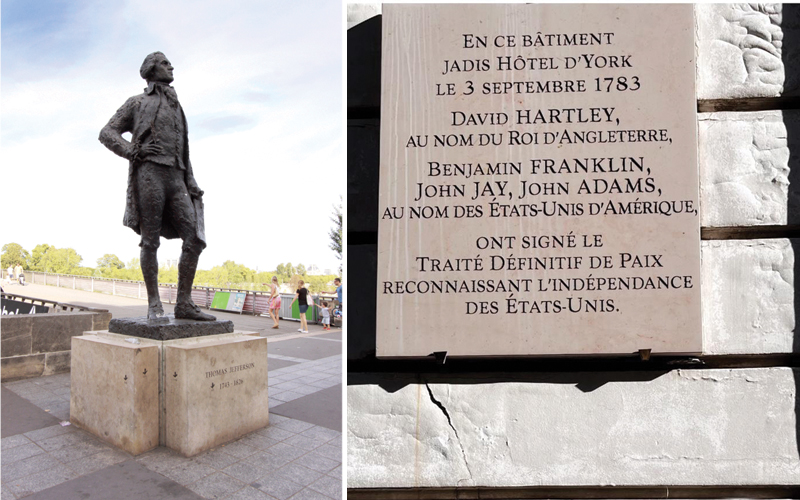
Caption: Statue of Thomas Jefferson in Paris. Plaque outside 56 Rue Jacob where the Peace Treaty was signed with Britain ending the American Revolution in 1783.
It’s the 250th Anniversary of the American Revolution. It’s also a very special year in France. Without the help of the French there might not have been a “United States of America” probably not even a “United Colonies of America.”
Ever since I visited Europe with my parents, we sought out European sites that related to America. Not far from London’s Savoy Hotel is the home of Benjamin Franklin, later America’s envoy to France. Benjamin Franklin, who ironically helped the American colonies separate from England – still exists in England. Whereas Franklin’s home in his hometown, Philadelphia, disappeared at almost the same time British troops disappeared from there.
It is apropos that France gave the United States the Statue of Liberty since France helped the United States get “Liberty” a century before the eponymous statue arrived in New York in 1886. And if you’re lonesome for the Statue of Liberty in Paris, just go to the replica of the Statue of Liberty on the Ile aux Cygnes perched in the direction facing New York. And if that Statue of Liberty doesn’t ignite a flame – go visit the sculpture of the Flamme de la Liberte (Lady Liberty’s Flame) resting above a highway – the highway where Princess Diana lost her life. And you’ll see piles of flowers and other honorary mementos resting beside it.
If you like realistic sculpture instead of “no particular name” sculptures such as “Miss Liberty” let’s look at the named sculpture that actually helped to get America Liberty and are commemorated in Paris – statues of real people. First let’s look at the statues of the First President of the United States – George Washington. Who does not stand alone.
He’s either on a horse or with a compatriot, the Marquis de La Fayette. I particularly like this bronze Equestrian Statue of George Washington for several reasons. It was designed by Daniel Chester French. If French sounds familiar, it’s because “French” who sounds more “French” than any sculptor anywhere in France is actually American. In fact, he’s so American that two decades later he designed one of America’s most renowned statues – Abraham Lincoln for Washington DC’s Lincoln Memorial. (And the base of his Paris Washington statue was designed by McKim – from the renowned US firm McKim Mead & White.) It’s just a short walk from the great views of the Eiffel Tower from the Trocadero to the Place d’Ilena home to the statue. (And when you’re there, I suggest, if time permits, a visit to my favorite museum of Asian Art – in or outside of Asia – the Musee Guimet.)
And if you want to see George Washington getting off his high horse, get to the Place des Etats-Unis apropos named “Place of the United States” to see the LaFayette and Washington Statue with the two standing side by side by Bartholdi (sculptor of the Statue of Liberty). Another favorite Bartholdi sculpture is just a few blocks away from NYU, where I lecture. It’s Lafayette in Union Square in Manhattan.
Benjamin Franklin traveled to Versailles to help King Louis XVI finance the American Revolution. That was a long trip for a man of his age. And once there he was also busy pushing off women who had father issues and were flirting with him (as is seen famous paintings). Because of his travels to Versailles at a more advanced age, it’s only proper that Benjamin Franklin’s Statue (located at Square Yorktown in Paris) is seated.
And now comes my favorite American Revolution revolutionary – Thomas Jefferson, whom I admire – and not just for this year’s 250th anniversary of his great writing of revolutionary thoughts for the Declaration of Independence. Let me declare – I admire Jefferson most for building new unique buildings for his new country – the United States of America.
When you have studied Thomas Jefferson’s architectural designs, you realize that Jefferson’s Paris statue is located where it truly belongs most – on the Seine next to the Hotel de Salm – the Museum of the Legion of Honor in the courtyard of the Musee d’Orsay. That building’s greatest honor is being admired by Thomas Jefferson so much that besides inspiring his design for his plantation, Monticello, it also inspired the design for the South Façade of America’s White House with its half-round, central projection. So next time you visit Paris’ Musee d’Orsay, just walk across the entrance courtyard and visit the Hotel de Salm and my favorite Parisian American Statue just waiting outside for you – Thomas Jefferson.