

Yamagata: A Journey into Japan’s Living Culture
Yamagata Prefecture, in northeastern Japan’s Tohoku region,
offers travelers a rare opportunity to experience a side of Japan where centuries-old traditions remain part of everyday life. From hot-spring inns and mountain temples to textiles, pottery, regional cuisine, sake brewing, taiko and traditional performing arts, Yamagata is a destination where culture is not simply observed—it is experienced firsthand.
Last December, I traveled to Yamagata with a group of travel advisors, mostly from Hawaii. At the time, Yamagata and Hawaii were negotiating a Sister-State relationship, which officially became effective on July 30, 2026. Our four-day cultural journey introduced us to welcoming accommodations, authentic cuisine and local people dedicated to preserving their traditions for future generations.
Arrival in Yamagata and a Traditional Onsen Stay
After arriving at Tokyo’s Haneda Airport, we took an evening Japan Airlines flight to Yamagata Airport. To encourage travel to regional Japan, Japan Airlines offers free domestic connections when domestic flights are booked in conjunction with international tickets. Discounted domestic fares are also available through the Japan Explorer Pass.
From the airport, we made a short transfer to Tendo Onsen and checked into Hohoemi-no-Yado Takinoyu (https://www.takinoyu.com/en), a traditional Japanese ryokan. My spacious tatami-mat suite featured a private cedar hot tub. That evening, the season’s first snow began to fall. Sitting in the steaming bath while cool air entered through the slightly open window and snow accumulated outside was both invigorating and peaceful—a perfect introduction to Yamagata.
Yonezawa: Textiles, Cuisine, Taiko and Sake
The following morning, we traveled south to Yonezawa, a historic castle town associated with the Uesugi clan. The surrounding Okitama region is known for its agricultural landscapes and rich cultural heritage.
At Yonezawa Nitta, a family-run textile workshop producing silk for five generations, we learned about traditional weaving and dyeing techniques. The region is particularly known for benibana, or safflower, which produces the traditional beni red dye. Creating the richest scarlet shade requires multiple dyeing cycles, with each taking hours. We tried our hand at tie-dyeing, creating pink-and-white patterns on handkerchiefs, and also experimented with weaving.
Lunch was served at the historic historic Uesugi Hakushaku Residence, an elegant former Uesugi family residence surrounded by a beautiful Japanese garden. Fresh snow enhanced the setting as we enjoyed Yamagata beef over rice with hot miso soup.
The afternoon brought a lively introduction to taiko drumming with the Minyouikka Taiko Group. Led by third-generation family head Jinichi Sato and his daughter, fourth-generation performer Hana, the group invited us to participate. The experience transformed a cultural performance into something personal and memorable.
We ended the day at Kojima Sohonten, brewers of Toko sake. The Kojima family has been producing sake since 1597 and once supplied the Uesugi family. After touring the historic brewery and sake museum, we sampled several award-winning varieties, including Toko Junmai Daiginjo Fukuro-Tsuri Juhachi, which received top honors at the 2024 International Wine Challenge.
Yamadera and the Flavors of Shonai
Our next morning began at Yamadera, one of Yamagata’s most iconic cultural landmarks. Founded more than 1,000 years ago by the Tendai Buddhist master Jikaku Daishi, also known as Ennin ,the temple complex is dramatically built into a forested mountainside. Visitors climb 1,015 stone steps past ancient graves, monuments, Buddhist statues and temple buildings to reach upper levels offering spectacular mountain views.
An English-speaking guide explained the temple’s history and spiritual traditions, including its connection to haiku poet Matsuo Bashō, who visited in 1689 during the journey chronicled in The Narrow Road to the Deep North.
Afterward, we stopped at Nice Spot Coffee before enjoying a noodle lunch at Fumotoya and continuing north toward Shonai region.
In Amarume, we visited Hanabusa Shoyu, a traditional soy sauce brewery founded in 1823. The Sato family has operated the business for generations, with current president Shinzaemon Sato representing the 15th generation. We observed traditional production methods and sampled different varieties of shoyu paired with fish, vegetables and cheese.
That evening, we checked into Kameya Hotel (https://www.kameya-net.com) in Yunohama Onsen, a seaside hot-spring resort in Tsuruoka. The highlight of the evening was an interactive dinner with Chef Suda, who demonstrated sushi preparation and fish filleting and introduced us to the specialized skills required to prepare fugu. It was dinner and culinary lesson in one.
Pickling, Maiko, Pottery and Yamagata Beef
Our final full day began at Honcho, a traditional tsukemono, or Japanese pickle, producer. Pickling has long been essential to Japanese food culture, both for preserving seasonal produce and accompanying meals. We toured the facility with third-generation owner and chairman Mr. Honma, sampled the products and learned how traditional methods are still used on a commercial scale.
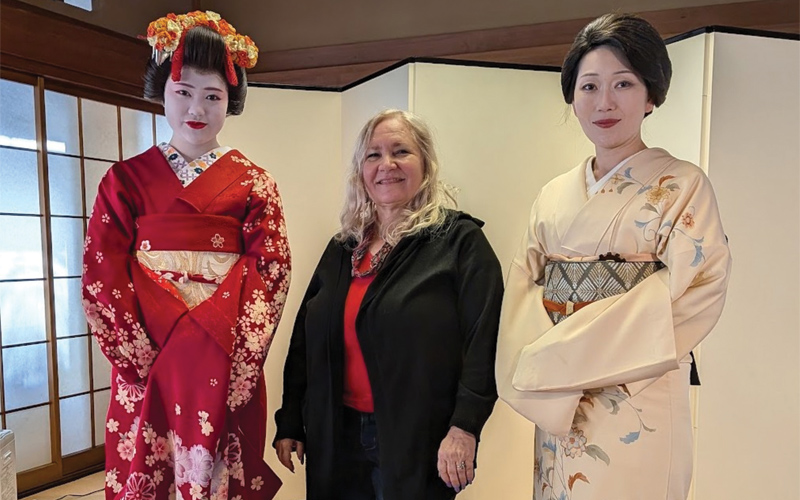
Lunch at Shisanro, a traditional ryotei offering kaiseki-style cuisine, included a private performance by a Yamagata maiko. We also had the opportunity to speak with her personally—an experience that demonstrated that authentic geisha culture can be found beyond Kyoto.
The afternoon brought another form of traditional craftsmanship at Hirashimizu, an ancient pottery village on the outskirts of Yamagata City. Working alongside a local artisan, we created our own ceramic pieces, which would later be shipped to us as souvenirs.
Our journey concluded at Yamagyu, a Yamagata yakiniku restaurant, where we gathered for our final meal and reflected on the experiences of the trip.
What makes Yamagata so compelling is the opportunity to move beyond sightseeing and participate in living traditions. Whether soaking in an outdoor onsen while snow falls, dyeing silk, beating taiko drums, tasting centuries-old sake, preparing fish, meeting a maiko or shaping pottery, visitors encounter a culture that remains deeply connected to its history while continuing to evolve.
For more information about Yamagata and arrangements for your clients, visit The Hidden Japan: https://thehiddenjapan.com/locations