

Reminisce the Gilded Age of Croatia’s “Austrian Riviera”
Long before tourists were thronging to the country for a visit to
Dubrovnik’s medieval walls or the popular island-hopping excursions, there was a part of Croatia that attracted Europe’s aristocracy alongside celebrated writers, artists, composers, and members of the continental intelligentsia.
Opatija: The Pearl of the Adriatic
Coined the Austrian Riviera, Opatija was a gilded-age seaside escape and by the turn of the twentieth century, it had earned its reputation with a picturesque coastline and refined atmosphere making it a much-preferred seaside escape for the Austro-Hungarian elite.
Though much has changed since its heyday, the area retains an unmistakable old-world charm, offering travelers a rare opportunity to immerse themselves in stunning architecture, historic seaside resorts, and the enduring glamour of the Belle Époque.
The Austrian Riviera sits along Croatia’s northern Adriatic coast in the Kvarner Gulf. If you are familiar with the resort town of Opatija you will know it sits in the middle of that bygone era’s playground. You will also find this same old-world charm extending through the nearby coastal communities of Lovran, Volosko, and Rijeka. As for the climate in this area, it is mild year-round and protected by the slopes of the Učka Mountain. The area became a touted paradise when in the late 1800s the railway connections from Vienna offered a fashionable winter resort for the elite and creative during the winter months.
Historic Hotels and Belle Époque Elegance
Looking first at Opatija – also known as the pearl of the Adriatic – it is worth visiting and the famous Hotel Kvarner is one of the oldest luxury hotels on the Adriatic. The hotel began construction in 1884 and from there grand villas, manicured gardens, and elegant promenades appeared along the waterfront soon thereafter.
Not a crowded beach destination vibe, visit Opatija if you enjoy leisurely strolls, concerts, and wellness treatments.
If you are not lucky enough to stay at Hotel Kvarner another few options are Amadria Park Hotel Milenij, a luxury waterfront property on the promenade, with modern comfort and historic surroundings. The Hotel Palace Bellevue is another option and an architectural gem where guests will find a good deal of the Austro-Hungarian character still intact along with contemporary amenities.
As for the 7.5-mile seaside Lungomare promenade it connects Opatija, to the two nearby villages of Volosko, and Lovran.
Strolling Through History
Overall, guests to the area come away with the overall feel of history, particularly when strolling on the promenade. Afterall, this landmark has become the epitome of the leisurely pace and grand indulgence that made the Austrian Riviera so well loved.
Take time to visit one of Opatija’s historic villas, such as the renowned Villa Angiolina, widely regarded as the birthplace of tourism in the region. Surrounded by lush botanical gardens filled with exotic plants from around the world, the villa now houses a museum that chronicles Opatija’s transformation from a quiet coastal town into one of Europe’s most fashionable seaside resorts.
Be sure and seek out the region’s most photographed landmark called the Maiden with the Seagull. She is standing on a rocky outcrop overlooking the sea and the symbol of Opatija.
Nature and Scenic Beauty Beyond the Coast
For nature lovers, Učka Nature Park offers hiking trails, panoramic viewpoints, and vistas that stretch across the Adriatic toward Italy.
A Culinary Crossroads of Europe
For foodies, the atmosphere of old-world charm will immediately give way to the local cuisine. The Austrian Riviera is located at the crossroads of Croatian, Italian, Austrian, and Central European influences. The Kvarner scampi is a fresh, local favorite from Kvarner Bay. The best way to experience it is grilled with olive oil and garlic. Black risotto made with cuttlefish ink is also a regional specialty found throughout the coast.
If you venture to the village of Lovran, named after Laurel, as shown in its coat of arms, the local sweet chestnuts are known as maroni. Each autumn the town hosts festivals celebrating the harvest with chestnut cakes, pastries, and desserts.
Throughout the Austrian Riviera there will also be no shortage of strudel and Austro-Hungarian pastries. In fact, cafés serve a variety of desserts reflecting the area’s imperial heritage with apple strudel, cream cakes, walnut pastries, and Viennese-style tortes.
And if you have heard of the local wine, you know the nearby Istrian Peninsula produces the white Malvazija and red Teran. These pair excellently with the local seafood dishes.
Exploring the Villages of Volosko and Lovran
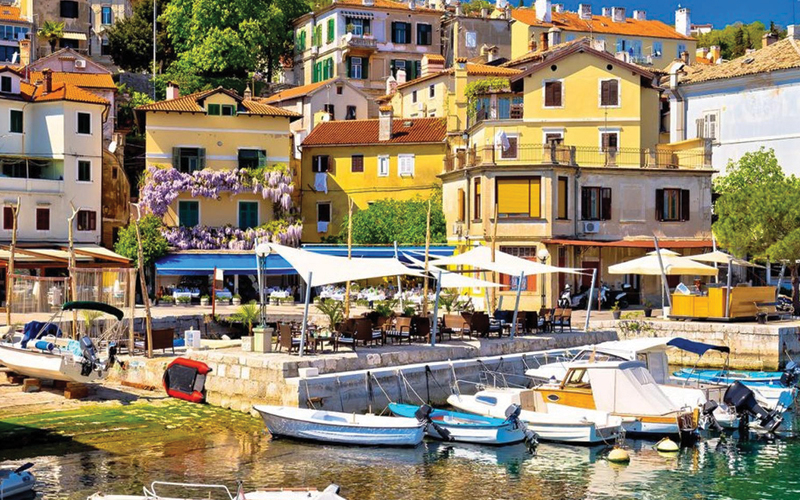
For a quieter stop Volosko is a quaint fishing village with narrow stone streets, fishing boats, and the seafood restaurants are renowned while at the same time creating an authentic atmosphere.
And if you venture out to locate the sweet chestnuts in Lovran, stay a few nights in this charming medieval town. The winding lanes and historic architecture boast centuries of Adriatic history that are worth exploring.
Rijeka: The Region’s Cultural Gateway
Finally, the village of Rijeka is a cultural scene in the area with a rich maritime history, and Austro-Hungarian architecture, for a few nights or a day trip, add it to your list.
A Timeless Alternative to Croatia’s Crowds
Croatia has much to offer, but the Austrian Riviera remains one of its best-kept secrets. Here, travelers can step into the world of emperors, aristocrats, and cultural luminaries while enjoying grand architecture, exceptional cuisine, and breathtaking Adriatic views. In an age of overtourism, this historic coastline offers something increasingly precious: timeless elegance, authentic charm, and room to savor it all at a leisurely pace.