

WATER TRAVELING BY AIR
The decision that many travelers face when planning a trip
abroad is whether to travel by water or air? That question still stands. This column is also about water and air – actually, water IN the air — great Water Fountains.
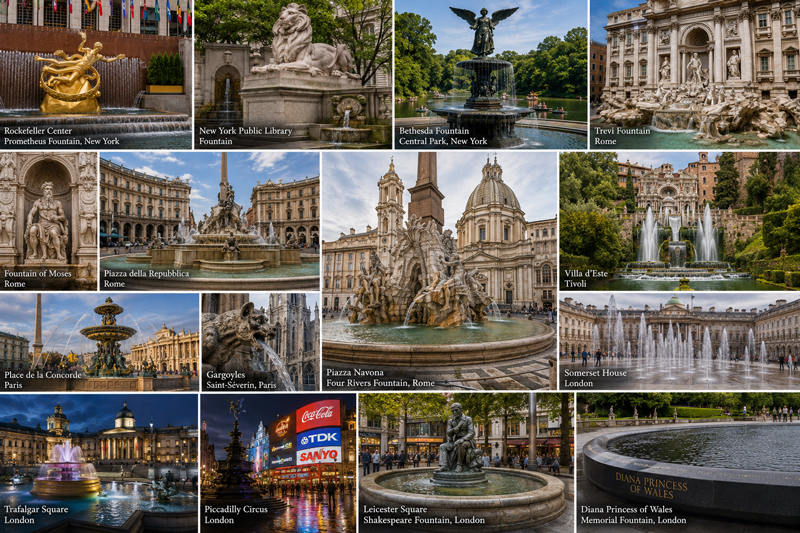
I like fountains so much that one of the first things I look for in any destination is its fountains. Since I live in Manhattan, let’s first look at fountains there. Perhaps Manhattan’s most famous fountain is Prometheus in Fifth Avenue’s Rockefeller Center. Sadly, you don’t notice it when looking from Firth Avenue because it’s below eye level. And unlike most great fountains around the world, the statue itself rests above the fountains so there’s no interaction between statue and fountains. When I was a child, I enjoyed visiting Rockefeller Center for fountains, its many fountains of fish spewing water, which I haven’t seen spewing water for quite some time.
One of the most famous libraries in America is the New York Public Library on Fifth Avenue and 42nd Street. The steps leading from Fifth Avenue are world famous for the statues of lions on both sides. However, if you walk up those stairs, into the wrap around park to the second flight of stairs, you’ll notice fountains below statues framing the next flight of stairs. Actually, since those fountains are so very small and not in the sight-line – you may not even notice them.
Now walk down Fifth Avenue to Central Park. Hidden in Central Park is the Bethesda Fountain. On the occasion it actually operates, you have to walk down two flights of stairs to see it. In just about any park in Europe, the fountain would be raised so that you’d see it far in the distance, and the delight would be the approach — the fountain getting bigger the closer you get until you finally hear it as well as see it.
Fountains spewing water are nothing new. Ancient Greece had them before the birth of Christ. During Roman times water fountains, to obtain water, operated in conjunction with aqueducts. During the Middle Ages fountains actually served a practical purpose – they were sources of drinking water. In the Renaissance fountains became works of art as well as a source of drinking water. And during the Renaissance – and especially during the later Baroque period – fountains were combined with statues and became works of art that centered around the importance and even visual appeal of water.
At first many fountains were attached to buildings such as Rome’s illustrious Fountain of Trevi and Rome’s Fountain of Moses. Later. fountains situated by themselves. became the attraction. And even later, fountains became a mainstay of city planning poised in the center of Traffic Circles such as in Rome’s Piazza República. And if you really like fountains, a must see is Piazza Navona with FOUR fountains including one by the great sculptor Gian Lorenzo Bernini.
If you like fountains, almost 100 years before Bernini there was the fantastic Villa d’Este in Tivoli, just outside Rome, with dramatic cascades and over 500 fountains fed by gravity. For fountain lovers, the Villa d’Este was built in the 16th century, which is also more than a century before the hunting lodge of Versailles even had a single fountain.
Paris is a city also defined by fountains. During the French Revolution, the Place de la Concorde didn’t have water flowing, it had blood flowing. The Place de la Concorde was the location of the guillotine. Today, its two elegant 18th-century Neoclassical buildings by Anges-Jacques Gabriel form the backdrop of the Place de la Concorde, with two elegant fountains framing an ancient Egyptian Obelisk. The Place de la Concorde only gets better. The building on the left is the famous and fabulous Hotel Crillon and the building on the right, which used to be the Ministry of the Navy, is now Paris’ latest fantastic museum with elegant 18th-century furniture and décor. One of Paris’ latest “must-sees.”
Paris is a city of parks — and in most of its parks and squares – there’s a fountain – and frequently more than one! While I really like Notre Dame Cathedral and laude the post-fire excellent restoration, there is one thing the square in front of Notre Dame does not have – a fountain . If you want to see a Paris church with water flowing — look no further than the nearby church of Saint Severin. In fact, when it rains, St. Severin is surrounded by fountains which are built-in Medieval Fountains attached to the roof – gargoyles — spewing water. A few years ago I took a group from a Manhattan temple to St. Severin preceding it with my introduction, “Have I got a GarGOYLE for you!”
As a child when my parents took me from Paris to London you had two choices — water or air. Now, to visit water traveling through the air in London, I opt for the train. London today has many more fountains than it did when I was a child. In fact, today there’s a whole courtyard full of fountains in Somerset House — just a few blocks from Trafalgar Square with its wonderful fountains. London, like Rome and Paris also has fountains in crucial squares and roundabouts. There’s a dilly of a fountain in Piccadilly Circus where during the night its fountains reflect bright lights from its theaters and movie houses. And Leicester Square has the elegant round Shakespeare Water Fountain. One of London’s latest fountains spouts water creating water for many of its visitors — TEARS! It’s the relatively new fountain in honor of Diana Princess of Wales.
At my age, I’ll always be looking for that special fountain — the Fountain of Youth!