

Finding Your Buen Camino in Northern Spain – Part 1
There are many ways to approach the Camino de Santiago with one thing in common:
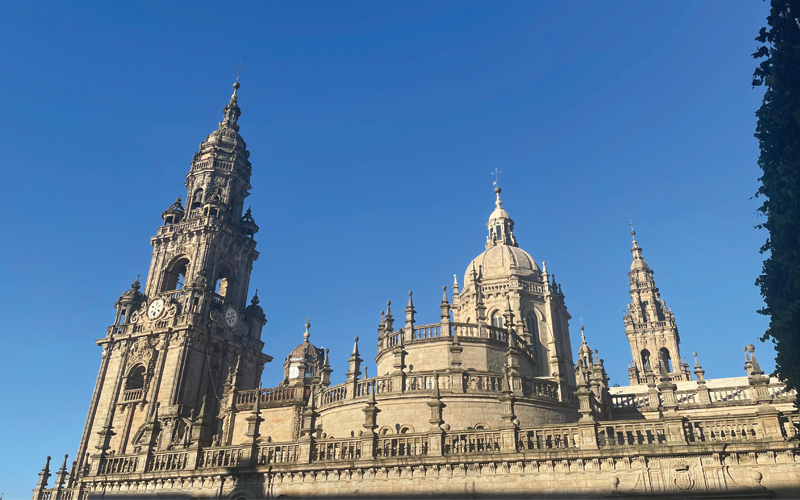
You’re bound to find a rich cultural and historical heritage, stunning landscapes and unparalleled culinary experiences.
No matter how busy your schedule is, or how sleepy you may be after a redeye flight and long drive, there is always time and energy in Castilla y Leon and Galicia, Spain for lunch. JAX FAX started the journey along the Camino de Santiago in the city of Burgos at the restaurant Puerta Real with a meal of pork loin with potatoes and seasoned green bell peppers and wine—with at least a few additional courses plus a dessert of cheese with honey and nuts.
Balancing conversation with mouthfuls of this exquisite feast, the ultimate purpose of the journey on the Camino de Santiago was discussed. As delightful as these indulgent meals are, the original purpose of the Camino was to make it to the Cathedral de Santiago where the remains of St. James are interred in a sepulcher. For that reason, those who make the journey are referred to as pilgrims.
Today, a religious odyssey is just one of many motivating forces for making the journey. You’re also highly likely in 2025 to run into pilgrims walking the Camino for self-fulfillment, self-discovery or to mark an important milestone like a 30th wedding anniversary.
The First of Many Magnificent Churches
With multiple goals in mind, from pure enjoyment to religious fulfillment, JAX FAX’s travel group left Puerta Real, for a walk to the Cathedral de Burgos, passing under the stunning Arco de Santa Maria on the way there. A walk of nearly any length in Northern Spain is likely to feature passages alongside or under breathtaking historical features, like this one, which dates to Medieval times and was then rebuilt in the 16th century.
The Cathedral de Burgos was just a short walk from the Arco de Santa Maria. The cathedral is known as a masterpiece of gothic architecture. Its construction began in the 13th century and continued with significant modifications in the 15th and 16th centuries. It is now a UNESCO World Heritage Site.
The history of Burgos dates to the 10th century, so after a tour of the Cathedral de Burgos, even a casual stroll comes with reminders of the people who populated that history, who many visitors to the country will likely be encountering for the first time. For example, you might run into a sculpture memorializing a figure like Rodrigo Diaz de Vivar, a Medieval Castilian knight and warlord.
Walking the Camino
JAX FAX’s tour group walked small portions of what is known as the French Way. This route begins in France, and to walk it from the beginning into Spain, requires hiking over the Pyrenees Mountains. JAX FAX’s first walk on the Camino began at the ruins of the San Anton Monastery, located near Castrojeriz, Spain.
American pilgrims who started their journey much earlier on the French Way were quickly encountered. A couple celebrating their 30th wedding anniversary with a walk along the Camino hiked the Pyrenees to get to that point on the path.
For pilgrims who seek a long, challenging journey, there are, in a literal sense, steep difficulties, but also tremendous camaraderie, with the pilgrims wishing each other a “Buen Camino.” The husband celebrating his wedding anniversary, for instance, gave a pair of padded socks to a stranger who complained of getting blisters on her feet.
Not all pilgrims seek such a harrowing journey nor are capable of it. For that reason, many choose to only hike a small portion that may mostly be on flat land. They also will likely choose to send their suitcases ahead of them to the hostel or hotel where they will spend the following night to lighten their load as much as possible.
This particular part of the Camino led to the Church of Nuestra Senora del Manzano (our Lady of the Apple Tree). It was built between the 15th and 18th centuries in a Gothic style. It houses a museum with a collection of religious art and artifacts.
Boat Ride Alongside the Camino
The Camino is typically completed on foot or by bicycle, but you can also take a boat ride alongside it on the Canal de Castilla, and even get your Camino “passport” stamped for having completed that part of the route. JAXFAX experienced a sightseeing tour on this canal via Barco turístico “Juan de Homar.”
This is the only part of the Camino that you can complete by boat. It’s a placid journey with a good breeze that whips up on the deck at the front and back of the boat. On JAX FAX’s time on the Juan de Homar, a multilingual guide, originally from Romania, told stories of the canal and Camino first in Spanish and then in English for the American tour group on board.
Mapping out your Camino route well enough in advance to know about the opportunity to traverse a small portion of it by boat is essential for those hoping to stay in public hostels, which offer free or very inexpensive lodging with one caveat: It’s first come, first served. If you get there too late in the day, you are liable to find the hostel where you hoped to stay full.
In addition to beating the heat during the summer, the pilgrims typically start walking on the Camino at daybreak or even slightly before to ensure they get a room for the night at a hostel.
Gaudi & Beyond in Leon and Astorga
A pilgrim with a passion for architecture will find much of interest on their journey in Leon. Not only are there gorgeous churches, as there are on many other parts of the Camino, but in Leon there is the Museo Gaudi Casa Botines. This building, designed by Antoni Gaudi, is known as a neo-Gothic masterpiece. It now functions solely as a museum.
It was originally constructed in 1893 to house a textile warehouse and apartments. It is considered a significant example of Gaudi’s work outside of Barcelona. It includes an art gallery with a collection of works by artists like Goya and Dali, among others.
A memorable work by Gaudi can also be seen in Astorga, the Episcopal Palace of Astorga, also known as the Palace of Gaudi. Construction of this gem began in 1889 and was completed in 1915.
Those who love architecture for the ages will also be drawn to the churches of Leon including the Leon Cathedral and the Basilica of San Isadoro. The Leon Cathedral is notable for its impressive quantity of Gothic stained glass, while the Basilica de San Isadoro is known for being an outstanding example of Romanesque architecture in Spain. It houses the Royal Pantheon, where many Kings and Queens of Leon were buried.
Speaking of kings and queens, there are so many castles in Castilla y Leon that it’s in the name of the region, “Castilla.” One of the castles pilgrims on the Camino will see that does not relate to kings or queens, but to knights, is the Castillo de los Templarios (Castle of the Knights Templar) in Ponferrada, about an hour’s drive from Astorga. These knights, who were part of the Christian Crusader movement, took it as part of their mission to protect pilgrims on the Camino in the 12th and 13th centuries. This castle is considered one of the largest and best-preserved Knights Templar castles in Europe.
Part 2 of this article will appear in the March/April issue.