

The Route Less Traveled: Cruising West Africa. From Dakar to Accra with Swan Hellenic’s Atlantic Crossroads
Swan Hellenic’s guiding mantra —
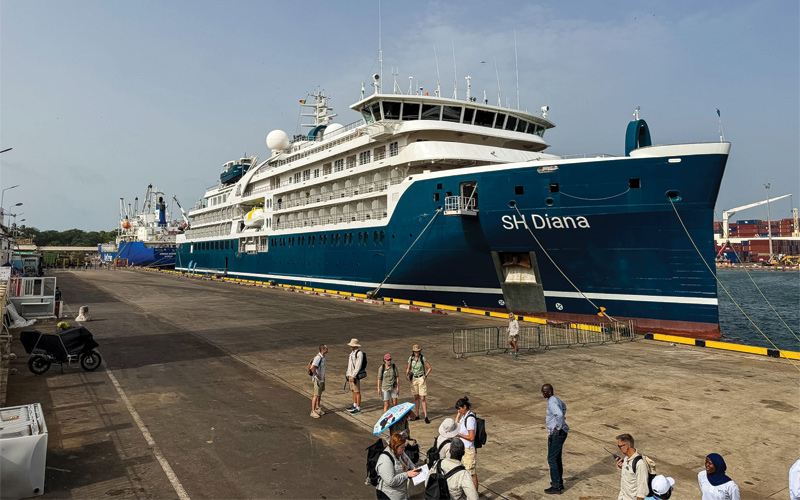
“See what others don’t” — speaks to every intrepid traveler with a discerning mind. I put the slogan to the test aboard the SH Diana on the cruise line’s Atlantic Crossroads voyage from Dakar to Accra. The itinerary spans seven West African countries, all far from the continent’s eastern coastline and Southern Africa’s pristine safari world.
Swan Hellenic began more than 70 years ago, taking Hellenic Society members to ancient Greek sites, with scholars serving as guides. That mix of exploration and education still shapes its voyages.
During nearly two weeks in Africa, guests became part of the Swan Hellenic family, visiting places far from most travelers’ radar—Guinea-Bissau’s secluded Bijagos archipelago, for instance. Assistant expedition leader Wendy Kaplan, from Buenos Aires, said the Diana was the only passenger ship in West Africa at the time.
Small ship, flexible spirit
To begin the voyage, I arrived early at the Pullman Dakar Teranga hotel in Senegal; Swan provides one night to rest and acclimate. The Diana, built in 2023 and designed for polar routes, holds up to 192 guests; 159 sailed with us. This voyage marked a transition for the Diana as she repositioned from her summer expedition schedule in the high Arctic (Svalbard, Iceland, Greenland) to her base in Ushuaia, Argentina, for the five-month Antarctica season.
Not all expedition ships are created equal. The Diana’s seven operating decks feel cozy and easy to manage. Zodiac excursions leave from Basecamp on Deck 3, which also holds the library and medical center. Deck 4 has the reception desk, a self-service laundry, and the Swan Restaurant, where a mostly Filipino team caters to every diner’s whim. The Observation Lounge on Deck 7 hosts daily briefings and lectures, and doubles as a stage where local entertainers invite guests to join in song and dance. Deck 8 holds the spa, gym, and sauna, and Deck 9 is an open stargazing deck.
At the welcome briefing, destination leader Sara Filié, from Italy, set out the spirit of the voyage: “Be flexible, show flexibility, and remember rule one.” In Africa, she warned, travelers should not be surprised by slow immigration officers, tardy pilots, buses a little short of VIP: It proved sound advice.
Days ashore, days at sea
As we left Senegal, Estonian Captain Jaanus Hannes hosted a welcome reception and introduced his senior officers. A visit to Gorée Island and the Door of No Return served as a reminder that this journey is very much about West Africa’s slave trade past.
The Diana slipped out of Dakar at 7 in the evening bound for neighboring The Gambia. Here guests could choose from tours and optional excursions, from mangrove cruises and the Makasutu forest to a sacred crocodile pool.
Each landing day began when color-coded groups were called to the Basecamp, where they stepped from the platform into Zodiacs. Days at sea ran on talks, observation, and binoculars — bird life with one guide, chimpanzees with another. Live briefings are also broadcast on cabin TV screens. Each evening, a pianist entertained while the team recapped the day and briefed the next.
Meals set the rhythm. Breakfast and lunch were buffets. Dinners were served in the Swan Restaurant with dishes such as garlic tiger shrimp, rack of lamb, and Thai chicken curry. Executive chef Ernesto Bron, from the Manila area, leads an 18-person galley, including a dozen cooks and chefs. The kitchen orders frozen beef and lamb, mostly from the United States and Australia, about two months ahead. “Running out is not an option,” Bron told me, so they always have extras, and you can order two mains if you like. It was no problem that my wife, Gaby, is dairy-free; the kitchen can prepare meals for any special diet.
Landing by Zodiac
Zodiac days start with a briefing from the expedition team, including Henri Leinfelder, an expedition guide from northern Germany who began his career lecturing on astronomy. The Diana carries 15 of the rugged inflatables, originally built for the French military. Guests learn the “sailor’s grip,” clasping forearms rather than hands when stepping aboard, and the drill that, if anyone falls overboard, everyone points so the driver never loses sight of the swimmer.
Lecturers urged guests to act as ambassadors. This meant not only smiling and asking permission before taking photographs. Visitors were asked not to give away pens or sweets that might make students sick or make them skip school, and to meet poverty with respect rather than pity. “That’s somebody’s home,” one lecturer said of the houses we would pass.
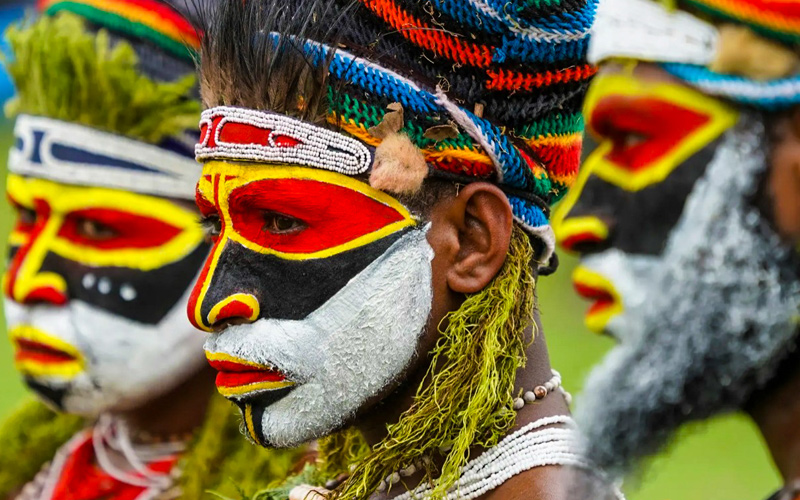
In Guinea-Bissau’s Bijagos Archipelago, we landed at Caravela and walked 4 km (2½ miles) to a ritual performance in a local community. The next morning we went ashore at Ampincha, a village of palm trees and sandy paths.
In Sierra Leone, I chose the Bunce Island tour to the well-preserved ruins of a slave fort in the Sierra Leone River, which historian Sarah Marshall called “quieter than Gorée.” An estimated 30,000 Africans were exiled there between 1670 and 1807.
A plaque there says British traders operated it. Our group saw the cramped, horrific conditions and heard stories of malnourished captives before they were loaded onto ships bound for the Americas. It is a history lesson we should never repeat.
In Monrovia, the ship’s arrival is still an event, and singers and dancers greeted us. Abidjan’s skyscrapers showed how quickly parts of this coast are changing, and on a tour to Grand Bassam many of us shopped at an artisan workshop for wooden carvings, textiles, and clothing.
Ghana closed the voyage with two rough days boarding Zodiacs at Elmina for tours to Elmina Castle, Cape Coast Castle, and Kakum National Park, plus a city tour of Accra for guests staying aboard for the next sailing, which would visit six more countries, ending in Angola. Elmina was the highlight of Ghana for me: two days of Zodiac landings at the old castle and fishing pier. The castle’s long role in the slave trade ended only as European powers outlawed it in the early 1800s.
Accra, my jumping-off point, is a busy capital whose economy tells a different story from the coast we had just seen. By one 2026 ranking, Ghana’s output per person, about $8,600 on a purchasing-power basis, is more than double Sierra Leone’s, roughly four times Liberia’s, and nowhere near the world’s twenty poorest countries. This expedition reminded me that West Africa is not one story.
The team behind the trip
The expedition team numbers around 13 and hails from Argentina, Germany, Italy, Britain, and beyond. Ian Valmont, from the Seychelles, has guided for more than 25 years and calls himself a generalist. Wendy Kaplan, from Argentina, runs daily operations and drives zodiacs. Behind them stand roughly 125 crew from 23-25 nationalities, over half Filipino; Henri believes a warm crew atmosphere sets Swan apart.
Sarah Marshall, an English journalist and historian from Hastings, gave talks that stayed with me. She said West Africa’s Guinean forests are one of Africa’s eight biodiversity hotspots. Yet, about 85 percent of the original habitat is gone, and conservation funding is scarcer than in East Africa. There is hope, though. One hero is Dr. Caleb Ofori-Boateng, a Ghanaian frog biologist who preaches conservation in churches and mosques in an “I love frogs, ask me why” T-shirt. Herp Conservation Ghana is West Africa’s first amphibian-focused conservation group.
The travelers
Swan Hellenic travelers are some of the most knowledgeable you will ever meet. Gaby and I immediately gravitated to Ray Miller and his wife, Deanne, both extraordinary travelers. When Ray and Deanne married, Ray promised to take her around the world. Her tally in the Travelers’ Century Club stands at 211 of 330 countries and territories, and this voyage added seven. “Being on a cruise is the perfect opportunity,” Ray said, and even a day or two in each country gives a representative overview. Ray guessed more than half of those aboard have passed 100 countries; about half sail on to Angola.
Grey Sample, a former Peace Corps volunteer in Jamaica, is on country 146. He boarded in Lisbon on 7 September and leaves the ship in Cape Town on 23 October, covering the whole West African coast. He likes small ships for the chance to “unpack once and be taken care of.” Liberia was his favorite stop because freed Americans returned there. He says travel is his drug of choice, and probably the healthiest one.
Where you haven’t been
Swan Hellenic covers the road less traveled. On the last day I asked Captain Hannes where to go next with Swan Hellenic. He is partial to Antarctica, where the Diana is headed, but his answer perfectly fit the entire voyage: where you haven’t been. On a coast that sees few tourists, a ship of seasoned travelers arrives as an event, and as Sarah Marshall put it, visitors can give communities pride in where they live.
For info visit: www.swanhellenic.com